Welcome Message
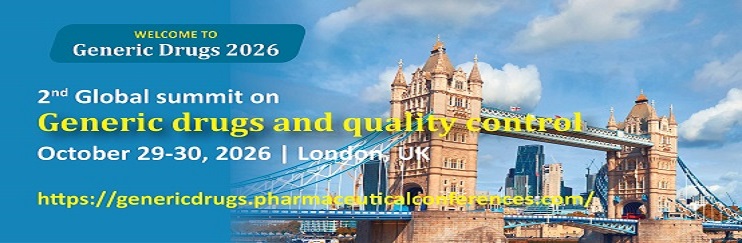
On behalf of the Organizing Committee, we are delighted to welcome researchers, scientists, pharmaceutical professionals, quality assurance experts, academicians, industry leaders, healthcare practitioners, and delegates from around the world to the 2nd Global Summit on Generic Drugs and Quality Control, taking place on October 29–30, 2026, in London, UK.
This summit serves as a premier platform to discuss the latest advancements, innovations, regulatory developments, and quality standards in the generic pharmaceutical industry. Under the theme of promoting affordable, safe, and high-quality medicines, the conference will foster knowledge exchange, collaboration, and scientific excellence among global experts.
Through keynote presentations, scientific sessions, and networking opportunities, participants will gain valuable insights into emerging trends and future directions in generic drug development and quality control.
We warmly invite you to join us in London for two inspiring days of learning, collaboration, and professional growth. We look forward to welcoming you to the 2nd Global Summit on Generic Drugs and Quality Control 2026.
About Webinar
We warmly invite global participants to attend the 2nd Global Summit on Generic Drugs and Quality Control, taking place on October 29–30, 2026 in London, UK. This international event brings together researchers, academicians, industry leaders, healthcare professionals, entrepreneurs, and students to share knowledge and innovations in pharmaceutical sciences.
The summit features keynote talks, invited lectures, oral and poster presentations, symposia, and B2B networking sessions with leading experts from the pharmaceutical sector.
Key focus areas include generic drug development, biosimilars, pharmaceutical formulation, analytical techniques, regulatory compliance, Good Manufacturing Practices (GMP), quality assurance, and bioequivalence studies.
This summit provides a platform to exchange ideas, promote innovation, strengthen academia–industry collaboration, and support the development of safe, effective, and affordable medicines worldwide.
Why to Attend
With participants from around the world focused on Generic Drugs and Quality Control, the 2nd Global Summit (Oct 29–30, 2026, London, UK) is a unique platform to connect with leading experts in the field. It offers an excellent opportunity to present research, share innovations, and exchange scientific knowledge with a global audience.
Engage with scientists, researchers, academicians, and industry professionals, and build valuable collaborations within the pharmaceutical community. Showcase new techniques and advancements in Generic Drugs and Quality Control while gaining international recognition and visibility.
This 2-day summit is designed to promote collaboration, innovation, and knowledge sharing across the global pharmaceutical sector.
Sessions And Tracks
Track 1: Advances in Generic Drug Development Strategies
Focus on innovative approaches in generic formulation, advanced analytical tools, computational modeling, and quality-driven development of complex generics including peptides, liposomes, and multi-component APIs. This track highlights the role of modern scientific techniques in improving efficiency, safety, and cost-effectiveness. It also emphasizes overcoming formulation challenges in complex generics to ensure therapeutic equivalence and regulatory compliance.
Explores updated BE/BA methodologies, regulatory expectations, pharmacokinetic modeling, and clinical endpoints ensuring safety, efficacy, and interchangeability of generic medicines. It provides insights into advanced study designs and statistical approaches used in drug evaluation. The track also focuses on improving accuracy in assessing drug performance in human systems.
Covers FDA, EMA, and global regulatory requirements, harmonization of standards, approval pathways, and evolving policies for generic drug registration. It discusses challenges in multi-region approvals and compliance strategies. The track also highlights the importance of aligning international regulations for faster market access.
Discusses challenges in developing complex formulations such as injectables, ophthalmic products, topical systems, and long-acting drug delivery technologies. It emphasizes formulation science and innovative delivery mechanisms. The track also explores strategies to improve stability, bioavailability, and patient compliance.
Highlights modern analytical techniques, validation methods, impurity profiling, stability testing, and quality-by-design (QbD) approaches. It focuses on ensuring product consistency, safety, and regulatory compliance. This track also explores advanced instrumentation and data-driven quality assessment tools.
Focus on Good Manufacturing Practices, audit systems, documentation, risk management, and maintaining product quality throughout the lifecycle. It emphasizes regulatory inspection readiness and continuous improvement systems. The track also highlights global GMP harmonization and quality culture in pharma industries.
Explores QSP, PBPK modeling, simulation tools, and data-driven approaches for improving generic drug development efficiency. It integrates biological, pharmacological, and mathematical models to predict drug behavior. The track also supports reducing development time and clinical trial costs.
Covers scale-up issues, cost optimization, production efficiency, supply chain challenges, and maintaining consistency in large-scale manufacturing. It also addresses technological barriers in production processes. The track highlights solutions for improving productivity while maintaining quality standards.
Discusses pricing strategies, market competition, intellectual property issues, and global commercialization challenges for generic drugs. It explores reimbursement systems and healthcare economics. The track also focuses on strategies to improve market penetration and affordability.
Focuses on biosimilar design, comparability studies, regulatory approval, and manufacturing complexities compared to traditional generics. It highlights scientific and regulatory hurdles in biosimilar development. The track also emphasizes global acceptance and clinical validation requirements.
Covers development and adoption of veterinary generics, regulatory updates, and cost-effective treatments for animal healthcare. It explores drug safety and efficacy in companion and livestock animals. The track also highlights growing market opportunities in veterinary pharmaceuticals.
Focus on post-marketing surveillance, adverse drug reaction reporting, and real-world safety evaluation of generic medicines. It emphasizes patient safety and risk management systems. The track also highlights global pharmacovigilance regulations and reporting frameworks.
Examines trust, awareness, misconceptions, and strategies to improve acceptance of generic drugs among healthcare consumers. It focuses on behavioral and psychological factors influencing drug choice. The track also promotes education to enhance confidence in generics.
Explores AI in drug development, nanotechnology applications, 3D printing of medicines, and smart pharmaceutical systems. It highlights digital transformation in pharmaceutical sciences. The track also discusses next-generation drug design and manufacturing innovations.
Discusses patent expiry, litigation issues, exclusivity periods, and legal aspects affecting generic drug entry. It explores strategies to navigate patent landscapes effectively. The track also focuses on balancing innovation and accessibility.
Focus on logistics, cold chain management, global distribution networks, and ensuring drug availability. It highlights challenges in maintaining quality during transportation. The track also emphasizes efficiency and transparency in pharmaceutical supply chains.
Covers clinical trial design, comparative studies, ethical considerations, and data interpretation in generics research. It emphasizes evidence-based validation of drug equivalence. The track also supports improving clinical research methodologies.
Highlights green chemistry, waste reduction, eco-friendly production methods, and sustainability in pharma industries. It focuses on reducing environmental footprint of drug manufacturing. The track also promotes responsible and sustainable industrial practices.
Explores machine learning, predictive analytics, automation, and digital tools in improving drug development and quality control. It emphasizes smart healthcare integration and data-driven decision-making. The track also highlights efficiency improvements through digital transformation.
Discusses emerging global needs, healthcare accessibility, innovation pipelines, and the future of affordable medicines worldwide. It focuses on evolving healthcare systems and patient-centric approaches. The track also highlights long-term sustainability and global collaboration in pharmaceutical advancement.
Target Audience
-
Generic Drug Manufacturers and Pharmaceutical Companies
-
Quality Control, Quality Assurance, and Regulatory Affairs Professionals
-
Pharmaceutical Scientists and Drug Development Researchers
-
Academicians, Professors, and Faculty Members in Pharmaceutical Sciences
-
Pharmaceutical Industry Executives and Decision Makers
-
Regulatory Authorities and Government Health Officials
-
Generic Drug Formulation and Development Specialists
-
Analytical Chemists and Laboratory Scientists
-
Good Manufacturing Practice (GMP) and Compliance Experts
-
Drug Safety, Pharmacovigilance, and Risk Management Professionals
-
Bioequivalence and Clinical Research Specialists
-
Contract Research Organizations (CROs) and Contract Manufacturing Organizations (CMOs)
-
Pharmaceutical Quality Systems and Validation Experts
-
Pharmaceutical Engineers and Process Development Professionals
-
Research Scholars, Postgraduate, and Doctoral Students in Pharmacy
-
Healthcare Professionals, Pharmacists, and Clinical Practitioners
-
Regulatory Consultants and Pharmaceutical Auditors
-
Pharmaceutical Supply Chain and Distribution Specialists
-
Biotechnology and Biosimilar Development Experts
-
Pharmaceutical Packaging and Stability Testing Professionals
-
Medical Affairs and Scientific Communications Specialists
-
Industry Associations and Pharmaceutical Trade Organizations
-
Pharmaceutical Technology and Laboratory Equipment Providers
-
Digital Health, AI, and Data Analytics Professionals in Pharma
-
Publishers, Scientific Journals, and Research Organizations
-
Investors, Entrepreneurs, and Start-up Innovators in Healthcare
-
Hospital and Healthcare Procurement Professionals
-
Global Health Organizations and Non-Governmental Organizations (NGOs)
-
Intellectual Property and Pharmaceutical Law Experts
-
Pharmaceutical Training and Continuing Education Providers
Market Analysis
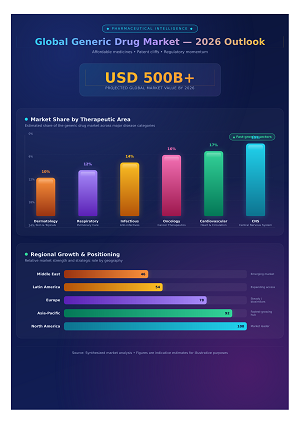
The global generic drug market continues to grow strongly, driven by rising healthcare costs, chronic disease burden, and increasing demand for affordable medicines. It is expected to exceed USD 500+ billion by 2026, supported by continuous patent expirations and government initiatives promoting generic substitution.
Key therapeutic areas include CNS, cardiovascular, oncology, respiratory, dermatology, and infectious diseases. North America leads the market with high generic prescription rates, while Europe shows steady growth due to cost-containment policies and biosimilar adoption.
The Asia-Pacific region, especially India and China, is the fastest-growing hub for generic drug manufacturing and exports, supported by increasing global regulatory approvals. Latin America and the Middle East are also expanding due to improved healthcare access.
Overall, advancements in quality control, GMP compliance, bioequivalence standards, and digital pharmaceutical technologies are shaping a more competitive, efficient, and innovation-driven global generic drug industry.